The Kaffeehaus: It represents a building that tells the story of a time of transition.
The Kaffeehaus, which does not evoke the classic Florentine style at all, was built when Florence came under the Lorraine after the end of the Medici era. It was the second half of the 18th century, and with the new rulers came different tastes, more “European.” Grand Duke Peter Leopold, very attentive to these changes, wanted a place to relax, away from the court, but still within the refined confines of the garden.
He chose a tranquil corner and ordered the construction of a small structure, elegant but not overly ostentatious. Architect Giuseppe Ruggieri designed an octagonal building with light decorations and that green dome that still makes it unmistakable today. It was all conceived for a simple activity: sitting down and enjoying a coffee, a novelty for the time. This typical dark beverage was not consumed in bars but in select venues among chosen guests, which is why the pavilion was not open to everyone but reserved for members of the court or special guests.
The very name, Kaffeehaus, is a direct reference to Viennese coffeehouses, centers of culture and conversation that were highly favored in the Habsburg realm. Introducing this concept to Florence was a novelty, even somewhat bold, considering the city’s sober and formal style.

Today, the pavilion no longer serves coffee, of course. But it remains there, perfectly integrated into the landscape, providing a different perspective of Florence and giving the sensation of being in another era.
The building’s location is not random. It sits on a raised point in the garden, offering a broad and impressive view of the city. The octagonal shape, the green copper dome, and the light external decorations immediately distinguish it from the other architectures present in the park. The loggias and the arched windows allow natural light to enter, giving the space a sense of openness and lightness. The interior retains some decorative traces from the era, but today it is primarily its historical and landscape value that makes it interesting.
The path to reach it, while slightly uphill, offers numerous opportunities to stop: shaded benches, small fountains, and statues immersed in greenery. Set within the broader context of the Boboli Gardens, the Kaffeehaus indeed represents a building that tells of a moment of transition, in which Florence, while maintaining its artistic identity, began to be influenced by ideas and styles from outside. In this way, the Kaffeehaus is not the center of the garden, but it is one of its most fascinating corners. A place that invites pause, contemplation, and—at least with imagination—a sip of coffee while enjoying the passage of time.
The Viottolone and the Statue of Abundance: Shady avenue leading to a symbol of prosperity
The Viottolone of the Boboli Gardens, one of the most picturesque corners of the entire complex, is defined by two precisely arranged rows of cypress trees that guide the eye along its length. The gentle slope makes the walk natural, calm, and almost “peaceful”… the same feeling that, perhaps, illustrious figures experienced in times past. The path is made of compact gravel, and it is easily accessible in every season, although it can become slippery when it rains.
Along the sides, stone statues depicting mythological characters and allegorical figures alternate, arranged according to principles of symmetry and “visual rhythm,” one behind the other. Some are still well-preserved, while others show signs of time, but all contribute to defining the space and the symbolic narrative of Medici power.
The Viottolone is not just a pathway; it is an architectural element designed to impress with the regularity of its layout. To this end, the height of the trees creates an effect that could be described as “perspective,” which recalls classical models interpreted in a Baroque style. Throughout the day, the light varies, offering new interpretations and views of the entire environment.

Continuing south, one reaches a higher area of the garden from which access to the Statue of Abundance is gained. Initiated by the sculptor Giambologna and completed by Pietro Tacca, the subject is a crowned female figure holding a rich cornucopia filled with fruits symbolizing abundance and prosperity. The placement is not random; the statue faces the city, almost emphasizing the connection between Medici governance and the fertility of the territory.
In fact, the Statue of Abundance is located on an elevated point that allows for a breathtaking open view of the city of Florence! On clear days, the dome of Santa Maria del Fiore and the outlines of the surrounding hills can be clearly distinguished.
The path leading to the statue is short, although it has some uphill sections with an uneven surface. For this reason, comfortable footwear and casual clothing are recommended. There are no benches nearby, but there are drinking fountains along the way. This area is less frequented compared to other parts of the garden, allowing for a more tranquil visit.
The entire route between the Viottolone and the Statue of Abundance can be completed in about thirty minutes at a moderate pace. However, it is advisable to take more time to observe the details of the sculptures and the arrangement of the space.
These two elements of the Boboli Gardens best represent the fusion of nature, art, and landscape architecture according to the principles of Florence during the Grand Duchy of Tuscany.
Discover the hidden gem: Giardino del Cavaliere, Florence
Hidden among the paths and terraces of the Boboli Gardens, the Garden of the Knight is one of those places not everyone knows about, but it is absolutely worth discovering. It may not have the grandeur of the Fountain of the Ocean or the eccentricity of the Buontalenti Grotto, but it offers a spectacular view of Florence and a more intimate, almost suspended atmosphere.
The location is slightly elevated, on the hill of the bastion of the Belvedere Fortress. It is reached by walking along the garden paths and ascending, where the city begins to feel increasingly distant. In fact, you “detach” yourself in height and it almost seems as though you “disappear” from Florence, even though you are still in the heart of the city.
The Garden of the Knight takes its name from the terrace on which it stands: the “Baluardo del Cavaliere,” built in the 16th century to strengthen the city’s defenses. This fortress was commissioned by Cosimo I de’ Medici during the height of wars and struggles for territorial control. Over time, the military space was transformed into a place of pleasure, adorned with flowers, statues, and an elegant loggia.
The terrace is spacious, surrounded by a decorated railing, and hosts a small formal garden in the “Italian” style. The flowerbeds are low, designed with symmetry, and bloom in spring with delicate colors. At the center, some symbolic statues dominate the space with understated elegance. It is a place that invites pause and contemplation, perfect for those seeking a less crowded area to stop for reading, taking a photo, or simply breathing.
On the side of the garden is also the building that houses the Museum of Porcelain, a valuable collection that includes tableware, ceramic sculptures, and European porcelain that belonged to the courts of Lorraine and the Medici. Admission is included in the Boboli ticket, so it’s worth a visit, even just to admire some unique hand-decorated pieces.
However, the true protagonist remains the panorama. From the Garden of the Knight, the view opens to the south, over the Chianti hills, and on clear days, the outlines of villas and olive groves can be distinguished. It is one of those points where Florence reveals itself in all its harmony, between nature and architecture.
Visiting the Garden of the Knight means discovering a more intimate corner of the Boboli Gardens. It is a silent, light-filled space that tells ancient stories but can also provide very simple moments: a pause, a breath, a glimpse to remember.
Buontalenti’s Grotto: a Renaissance masterpiece in the Boboli Gardens, between art and nature.
The Buontalenti Grotto in the Boboli Gardens does not go unnoticed, even by the most distracted visitors.
Built at the behest of Francesco I de’ Medici, its construction took place between 1583 and 1593. Bernardo Buontalenti, an architect, artist, and set designer well-known at the time, was called upon to direct the works. In short, he was a true man of his time. Indeed, the cave that bears his name is not just a grotto; it is a stone set design, a place that blends styles, illusions, and technical genius.
The grotto is located right at the entrance to the garden, on the left side of the courtyard that connects Boboli to Palazzo Pitti. Just approaching it reveals the details: sculpted stalactites, rough surfaces eroded by time, and stone masks that almost resemble faces carved in moss.
Everything is crafted to make the visitor believe they are in front of something ancient and natural, when in fact every element has been created with meticulous care. Buontalenti, after all, knew how to enchant. Here, among faux stones and artistic illusions, he demonstrates this fully.
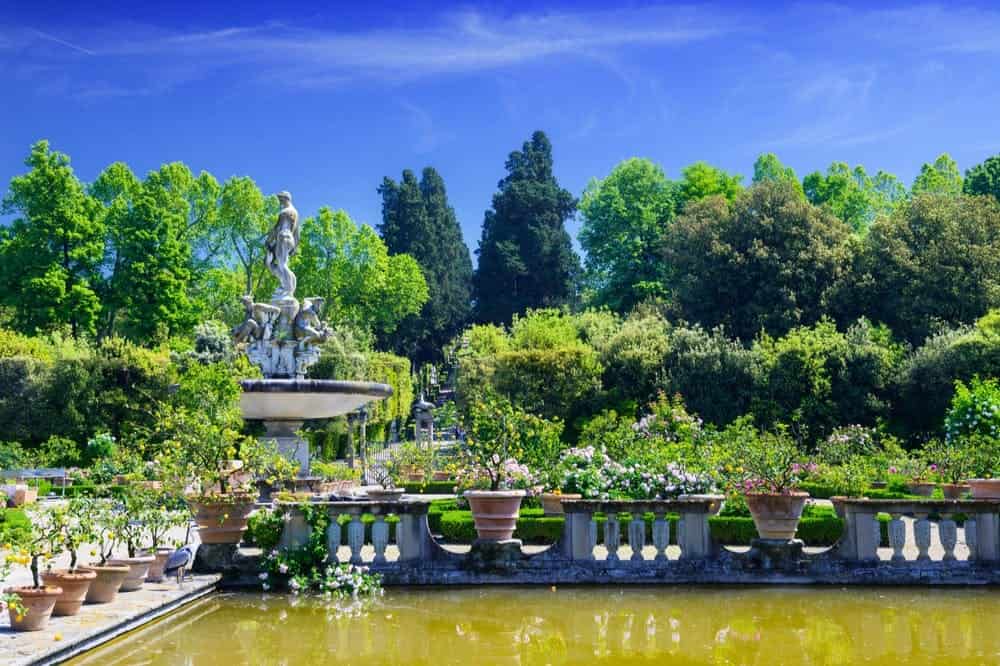
Inside, the environment is divided into three rooms, each with its own set design. In the first room, visitors are welcomed by an abundance of calcareous formations, stucco plant elements, and a decorated upper wall that seems alive.
The second room houses the famous statues of the Prisoners by Michelangelo (now copies; the originals are at the Louvre), set like in a natural prison, appearing to emerge from the walls as if trying to free themselves. This reflects the theme of “unfinished,” which was dear to the Renaissance, presented in an almost theatrical manner.
In the third room, there once stood the famous “Venus of Buontalenti” by Giambologna, which is now housed in the Bargello Museum. At the center, a small basin suggests the idea of a magical spring, while Venus appears surrounded by marine elements, shells, and moss. It feels like entering an aquatic dream, if only one allows a moment of silence.
Every detail is crafted to create the illusion of the natural world taking shape from art. Lights and shadows play with the reliefs on the walls, and for a moment, one forgets they are in a Renaissance garden: it almost feels like stepping into a dream.
The Buontalenti Grotto is not just a must-see for those visiting Boboli; it is one of the most captivating experiences Florence has to offer. A hidden corner, often not crowded, where fantasy and history blend uniquely. A true gem, not to be missed.
The Fountain of Neptune: The impressive Roman god in a dramatic display
Walking through the Boboli Gardens, it is almost impossible not to be struck by the solemn presence of the Fountain of Neptune, which stands out for its elegance in the upper part of the park, near the Chestnut Meadow. Its elevated position offers a broad view, both of the greenery and the Florentine panorama, creating a privileged observation point.
The fountain was created in the second half of the 16th century. The work was entrusted to Stoldo Lorenzi, a Tuscan sculptor from the circle of Giambologna, who crafted a grand creation whose features and beauty are appreciated even today. The figure of Neptune dominates the scene: powerful, standing tall with his trident raised, as if he were calling upon the forces of water. His pose is not only aesthetic but deeply symbolic. For the Medici, the great and powerful Tuscan family who commissioned the work, it represented dominion not only over water but more generally over nature itself.
Interestingly, the fountain was not originally located where we see it today. Initially, it was positioned at the center of the Amphitheater of the Garden, near the courtyard of Palazzo Pitti, before being moved to the western part of the garden later on for better enhancement. This choice was not uncommon in large Italian gardens, where the landscape was constantly reorganized according to precise visions of harmony and power.

The area that houses the sculpture has a simple but well-proportioned shape, and all around it opens up a clearing that, on less crowded days, becomes a silent corner. Sitting here, perhaps in the morning when there are few people to disturb the peace, is a unique experience: one gets the impression of being observed by the god Neptune himself, while the branches of the trees gently sway in the wind.
A detail often overlooked is that this fountain also served as a collection point for the water needed for irrigating the garden. Like many Renaissance works, it combined beauty and functionality, adhering to that distinctly Florentine logic of efficiency disguised as elegance.
To reach it, one starts from the courtyard of Palazzo Pitti and walks upward. The ascent is brief but slightly steep: nothing too strenuous, but it is worth taking your time. Especially for those with mobility disabilities, the path may be less suitable. In the end, the reward is an outdoor work of art, immersed in a landscape that seems hand-drawn.
The Fountain of Neptune is more than just a simple sculpture. It is a perfect example of how art, politics, and nature can coexist in balance. A stop not to be missed.
Discover the serene beauty and rich history of the Boboli Amphitheatre
Within the majestic Boboli Gardens, behind the grandeur of Palazzo Pitti, lies one of the most significant areas of the park: the Amphitheater. We are not talking about a simple open space, but rather a true stage of stone and greenery, capable of narrating centuries of history, taste, and power. It is not, in fact, a classical theater designed to host Greek tragedies or comedies. Its origins are decidedly more practical: at this location, during the construction of the palace, stone was quarried. When the quarry was exhausted, the Medici, always attentive to scenery and beauty, decided to transform that space into a representation area. This transformation took place around the second half of the 16th century. The initial layout was designed by Niccolò Tribolo and completed by other architects like Ammannati and later the Parigi family. What we see today is the result of multiple interventions, with additional elements added in the 17th and 18th centuries.
The result is an elegant semicircle of stone seating, adorned with statues and decorations, which has served for centuries for parties, performances, and shows.
Immediately striking is the obelisk that rises at the center. It comes directly from Egypt, specifically from Luxor, and is a rare example of pharaonic art in Tuscany. In front of it, a Roman basin made of green granite creates a visual contrast with the light stone of the seating. The effect is scenic yet never excessive.

Surrounding the amphitheater, carefully placed among the hedges and along the perimeter, are statues of deities and mythological figures. Many are copies of classical models, chosen to enhance the solemn atmosphere of the place. The proportions are well-considered, yet the impact remains surprisingly natural.
During the 17th and 18th centuries, the amphitheater was the center of the court’s social life: allegorical parades, water games, music, and movable scenery. Today, it is a quiet, almost meditative space frequented by curious visitors or those simply seeking a tranquil corner to pause.
It is easily reached by walking upward from the courtyard of Palazzo Pitti. The amphitheater of the Boboli Gardens is indeed an area to be explored at a leisurely pace, and the most curious visitors linger over every small detail. It is a place that invites tranquility and reflection; therefore, it is recommended to visit it early in the morning during the late spring days when there aren’t too many crowds that often disturb the natural quiet of the place.
Those who visit Boboli without stopping here miss one of its most emblematic spots. The Amphitheater is not just a stop: it is the heart of the park, where the past and landscape merge into a beauty that needs no words.
A lush sculpture park overlooking the Tuscan countryside
Anyone wishing to visit the Boboli Gardens without long waits has the opportunity to access the park through a reserved entrance system. This method allows entry through a dedicated entrance, with a pre-established time slot and digital ticket verification directly from one’s own device, avoiding the ticket office. The ticket can be shown on the phone, without the need for printing.
This type of access is designed to facilitate visitors during the high season, when queues at the entrance of Palazzo Pitti can take even dozens of minutes. Priority entry ensures a quick passage, leaving more time for the actual visit. Once inside, the pathway is free, allowing visitors to explore the entire park independently.
The ticket also includes the Bardini Garden, with its famous flowering pergola, and the Museum of Porcelain, located in the Palazzina del Cavaliere. These are three distinct locations, united by a noble origin and a scenic layout. The gardens were created to impress, framing parties, receptions, and moments of representation for the grand-ducal court. However, access to the Buontalenti Grotto and the audio guide is excluded; the audio guide is available at the ticket office in English, Spanish, Italian, French, German, and Japanese.
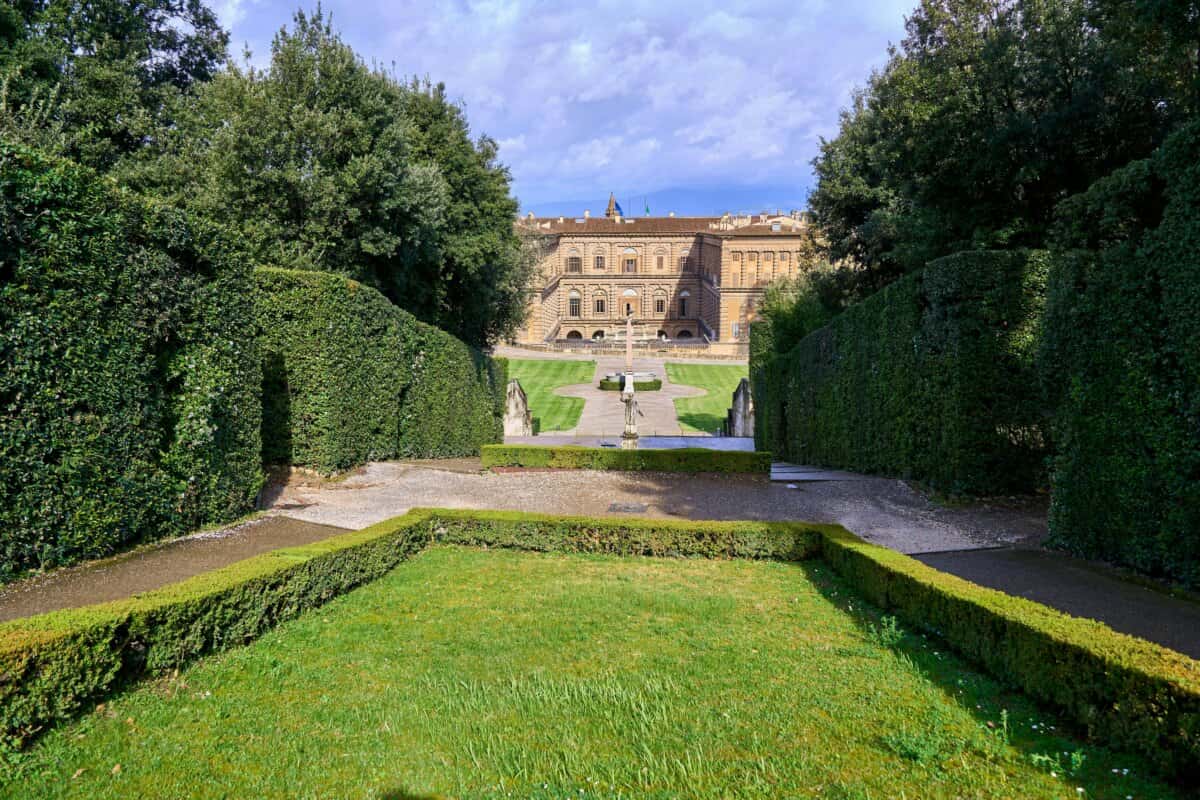
Upon entry, one encounters the Amphitheater, decorated with classical sculptures, from which a path ascends towards the basin with the Fountain of Neptune. Continuing upward, one reaches the terrace of the Kaffeehaus, an octagonal structure in Rococo style that offers a glimpse of the city and the surrounding hills.
Among the most striking attractions is the Buontalenti Grotto, a true architectural work of art hidden among the hedges, adorned with artificial stalactites, shells, and mythological figures. The reserved access allows visitors to admire these details without the pressure of waiting groups.
The journey can be undertaken at different paces: some choose a quick walk to the Isolotto, while others linger by the statues, perhaps to read a book or take photographs. The daily validity of the ticket allows for complete freedom in managing time. A full refund is possible by selecting a refundable ticket during checkout and canceling the visit by 11:59 PM the day before. However, the visit cannot be rescheduled.
For those visiting Florence even for just one day, this option, available in every season and accessible to all budgets, represents a convenient, efficient choice that respects travel times. The experience begins at the time set by the purchaser without any unforeseen events and takes place in one of the most enchanting settings in Italy.
 English
 Czech
 Danish
 German
 Greek
 Spanish
 French
 Korean
 Italian
 Dutch
 Japanese
 Portuguese
 Polish
 Russian
 Swedish
 Chinese
